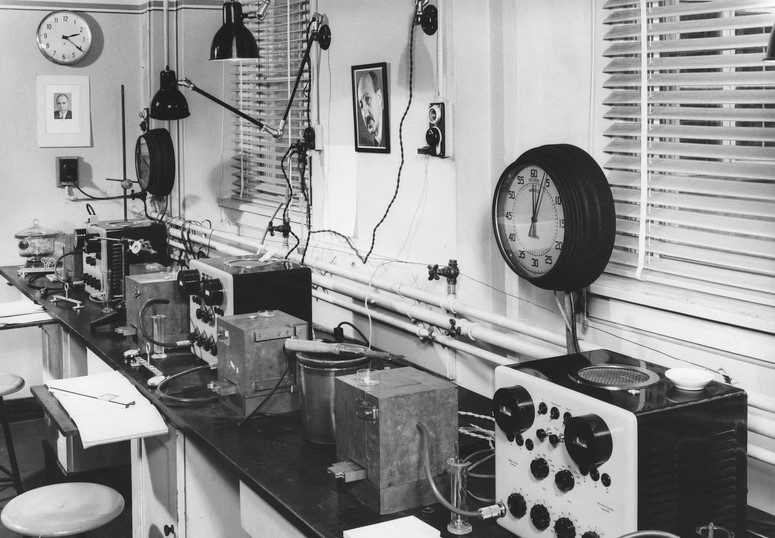

Joseph Woodrow Weinberg made a name for himself as an influential physicist. However, his reputation was tarnished by accusations from the House Un-American Activities Committee, which alleged he was spying for the Soviet Union. Shortly after, the scientist was also charged with perjury. Read on at i-queens to learn more about this brilliant yet controversial New Yorker.
Education and Academic Career
Joseph Woodrow Weinberg was born on January 19, 1917, in the Maspeth neighborhood of Queens. His Jewish parents had immigrated to the United States from Poland. At 19, Joseph earned his Bachelor of Science in Physics from the City College of New York.
From 1938 to 1939, Weinberg pursued his master’s degree in physics at the University of Wisconsin-Madison, where he met his future wife, Merle Hoesly. Joseph then worked on his doctoral dissertation at the University of California, Berkeley. After earning his PhD, Weinberg taught at Berkeley until 1947. Notably, Berkeley is the oldest and most prestigious campus in the University of California system, which includes 10 campuses across the state.
In 1948, Weinberg was appointed associate professor of physics at the University of Minnesota, a research institution and the largest and oldest campus in the University of Minnesota system. There, he studied the gravitational stability of white dwarfs—low-luminosity stars in the final stage of their evolution, with a mass about eight times less than that of the Sun. These stars also rotate, have a magnetic field, and are composed of helium or oxygen, neon, and magnesium.
The Manhattan Project
During World War II, Weinberg worked at the Berkeley Radiation Laboratory on the development of the atomic bomb. This assignment was part of the Manhattan Project—a top-secret U.S. program to create nuclear weapons. The project involved scientists from the United States, Canada, the United Kingdom, and Germany. Thousands of researchers lived with their families on secret military bases in remote locations. The project had a fateful impact on history, leading to the atomic bombings of the Japanese cities of Hiroshima and Nagasaki and the deaths of over 100,000 people.

However, the Manhattan Project also had positive consequences. It spurred innovations in medicine, civilian nuclear energy, and space exploration.
“Scientist X”
In 1949, the House Un-American Activities Committee launched an investigation into Weinberg. The physicist was accused of being “Scientist X.” Specifically, it was alleged that he had shared atomic secrets with the Soviet Union through a communist activist named Steve Nelson.
In 1951, Weinberg was fired from the University of Minnesota upon the recommendation of the university’s president. A year later, he was indicted for perjury for testimony he gave to the committee. Although he was acquitted in 1953, he was not reinstated at the university.
Weinberg worked briefly for the American Institute of Physics, contributing to its journal, Physical Review. The publication features original research as well as review articles and literature surveys. In 1953, he moved to the private sector, joining the Chicago-based optical company House of Vision. He later began working for Pioneer Scientific Company, a supplier of freight scales.
In 1957, Weinberg returned to academia, taking a position at Case Western Reserve University in Ohio. There, he researched theories of gravitation, magnetic resonance, and optics. In 1970, Joseph became a professor at Syracuse University, where he was named professor emeritus 14 years later. The physicist died of cancer in 2002 at the age of 85.