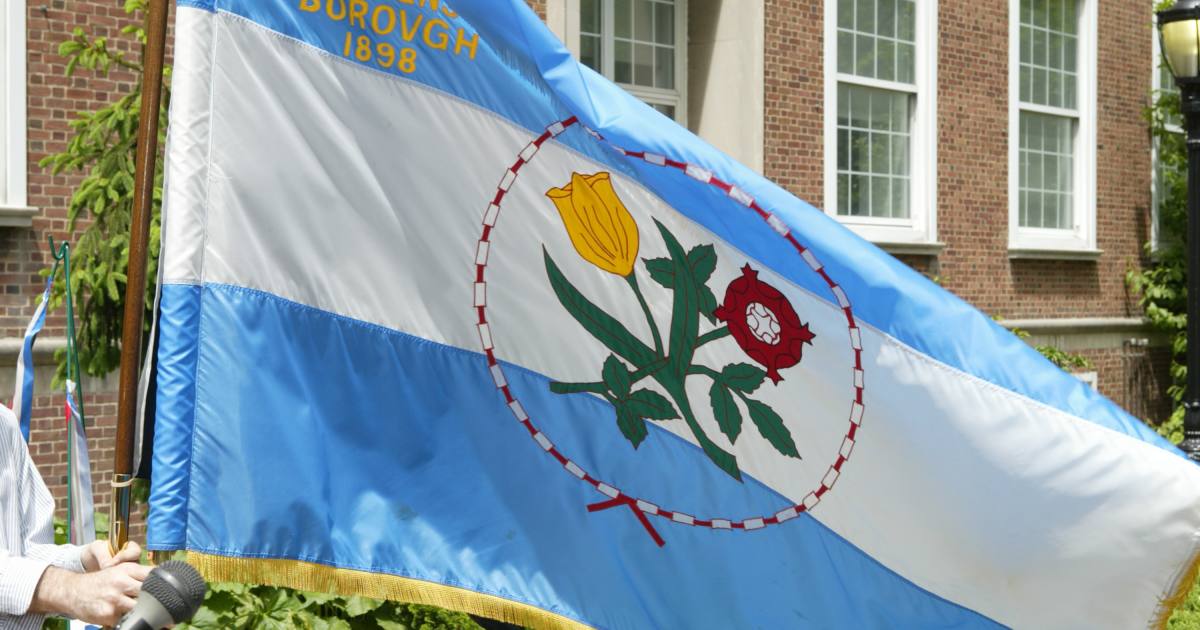

Flags are a powerful means of communication, consistently conveying specific messages and embodying ideals through their design and symbolism. Colors, patterns and more frequently hold significant historical, cultural and political meanings. Not only does New York City have a flag of its own, but each of its Boroughs has one as well. Learn about the flag of Queens and briefly explore the symbols of other parts of the city on i-queens.
Who authored the design?
The flag of Queens has been around since 1913. At that time, the Queens Borough Chamber of Commerce suggested to Borough President Maurice E. Connolly that an official flag be designed. Mr. Connolly was on board and tasked draftsman Rodman J. Pearson with creating the initial sketches.
On June 3, 1913, the Board of Directors of Queens Borough Chamber of Commerce presented an enhanced sketch of the flag following discussions by a designated committee. The updated flag was officially unveiled during the celebration of the opening of the Dual Subway System in Queens on June 7, 1913.
A hint of historical background
The yellow tulip represents the Dutch, the red rose is for the British and the wampum stands for the Native Americans. In Native American tribes, wampum (a shell bead) was used primarily as money and collateral. It is interesting to note that the name of Long Island sounds like ‘Sewanhaka’, which means the ‘island of shells’ in the Native American language.
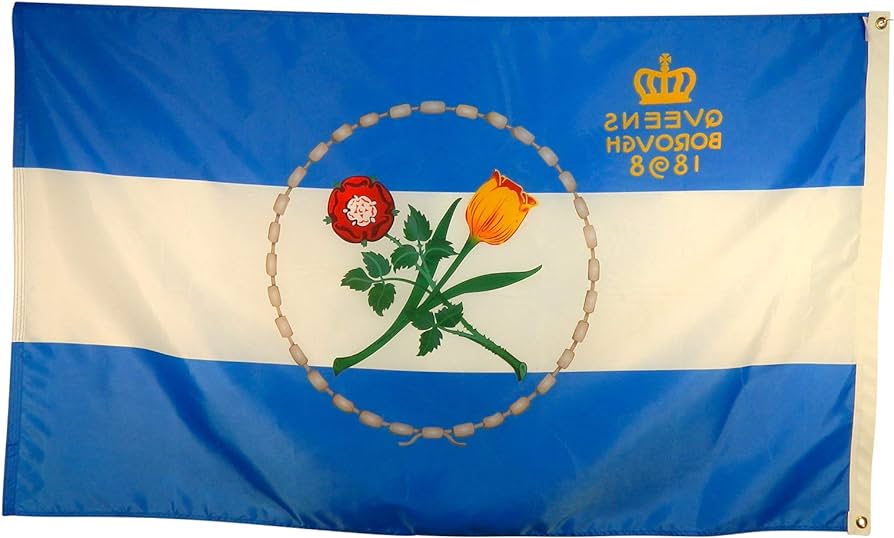
The symbols on the Borough’s flag and seal provide insight into the origins of Queens. The land was acquired by William Kieft, Governor of the Netherlands, from the Native Americans. Queens County was established on this site on November 1, 1683. It was named after Catherine of Braganza, who was the Queen of England, Scotland and Ireland and the wife of King Charles II of England.
The flag bears the date 1898 when Queens became one of the five Boroughs of New York City through consolidation. It is also a county in New York State. The white and blue colors are derived from William Kieft’s shield.
Unveiling the meaning of other Boroughs’ flags
The Bronx was the very first Borough to adopt an official flag back in 1912, predating even the flag of New York City. The flag features the original colors of the Netherlands—orange, white and blue—reflecting its history as a Dutch colony. An eagle, oriented towards the east, symbolizes the hope associated with the New World while honoring its ancestral roots. The shield’s sea represents trade and commerce, while the rising sun signifies the dawn of freedom. The ribbon with the Latin phrase ‘Ne Cede Malis’ translates to ‘Yield not to evil.’ Lastly, the laurel wreath surrounding the design signifies honor and recognition.
The flag of Brooklyn stands out from all others by its appearance. It has been around since 1860, when Brooklyn was an independent city and has remained unchanged since then. Its colors include white, blue, blue and gold. The lady depicted on the flag is the goddess of justice. She carries a Roman fasces, which symbolizes unity. This fasces has six rods that stand for the original six towns of Brooklyn. The Dutch motto above Lady Justice translates to, ‘In unity, there is strength.’
The flag of Manhattan closely resembles the official flag of New York City, featuring blue, white and orange colors along with a specific pattern. The figures on the flag symbolize Native Americans, while the sailor represents the city’s strong maritime history. At the top, the eagle signifies New York’s status as an American city rather than a Dutch or British one. Since 1782, the bald eagle has been a national symbol of the United States and is legally protected. This majestic bird can be seen on the American flag, government buildings, coins, envelopes, stamps and the Great Seal of the United States.
The flag of Staten Island received a slight redesign in 2016, making it the most recent flag among the boroughs. Similar to the flag of Brooklyn, it has a unique appearance. The flag features a ship and a small canoe with three oyster fishermen on a green background, highlighting the importance of oyster beds in the Island’s history. A female figure on the shore symbolizes the city, with her sword pointing downwards to signify peace. Two turtle doves on her shield symbolize camaraderie and loyalty. The two doves on her shield symbolize friendship and loyalty.